The Sanitary Towels Bill: What It Actually Means for Kenyan Girls
Every few months, a headline circulates that Kenya is about to guarantee free sanitary towels for every girl in a public institution. Parents share it. Teachers mention it in assemblies. Then the term starts, the shelves in the school store room are still empty, and the girls who needed that promise to be true this month are still improvising with whatever they can find.
So what is actually true about the Sanitary Towels Bill, what has already happened, and what is still just a proposal? Here is the honest breakdown.
What the Bill is trying to do
The Sanitary Towels Bill is legislation aimed at guaranteeing quality, free, and sufficient sanitary towels in all public institutions in Kenya, meaning schools, and in some drafts, other public facilities as well. The intent is to move menstrual product access from charity and inconsistent county budgets to a legal right backed by a national budget line.
That distinction matters more than it sounds. A charity donation depends on whether an NGO reaches your county this term. A legal entitlement does not.
What has already happened, separate from the Bill
Kenya has real, already implemented policy in this space, and it is worth knowing the difference between what is law now and what is still pending.
Kenya removed value added tax on sanitary products years ago, one of the first countries globally to do so, which lowered retail prices industry wide. There is also a national Menstrual Hygiene Management Policy covering 2019 to 2030, which sets out the government's stated commitments on education, product access, and facilities in schools. Kenya's constitution itself, under Article 43, guarantees the right to the highest attainable standard of health, including reproductive health care, and Articles 53 and 54 extend health protections specifically to children and to persons with disabilities.
Those are the legal foundations already in place. The Sanitary Towels Bill would sit on top of them, turning "the government supports menstrual health" into "the government must fund and deliver it, by law, in every public institution."
Why a bill on paper has not fixed the problem yet
Passing a law and funding a law consistently across 47 counties are two different projects. Distribution of free pads to schools in Kenya has happened, but reporting from county governments and local news has documented repeated delays, gaps between counties, and terms where the promised supply simply did not arrive on time. A Woman Representative in Busia County publicly flagged exactly this kind of delay in sanitary pad distribution as recently as this year, which tells you the gap between policy and delivery is still current, not historical.
This is normal for large scale public procurement and distribution in any country, but it means a law passing does not instantly mean a law delivering. Someone still has to get the product from a warehouse to a girl's desk, every single month, in every single county, without fail.
Why this still matters for the work happening on the ground
None of this is a reason to wait and see. It is the opposite. Every organization working directly with girls right now, distributing products, teaching menstrual health, mentoring girls through this stage of life, is not competing with government policy, it is the thing making sure girls do not fall through the gap while that policy gets built out fully. Legislation sets the floor. Local, consistent, community level work is what actually holds girls up while the floor gets built under them.
What you can actually do with this information
If you are a parent, teacher, or advocate, knowing the difference between what is already law and what is still pending gives you something specific to ask your local leaders: not "is there a policy," because there is, but "where is the distribution in our county this term, and who is accountable when it does not arrive."
If you are someone who wants to help close the gap directly rather than wait for full implementation, supporting organizations already doing the on the ground work, product distribution, education, mentorship, is the fastest way to make sure a specific girl in a specific school does not miss this month because a bill is still moving through committee.
Her Flow Initiative works in Sondu, Kisumu County, doing exactly that kind of steady, local work, so that girls are not waiting on Nairobi to decide whether they get to stay in class this term. Follow the work, and if you can, support it. Policy takes years. A girl's education cannot wait years for policy to catch up.
Questions people keep asking about the Sanitary Towels Bill
Has the Sanitary Towels Bill actually been passed into law? As of this writing it remains legislation aimed at guaranteeing free, sufficient sanitary towels in public institutions. Check current Kenya Gazette notices or your county government's communications for the latest status, since bill status can change with each parliamentary session.
Does Kenya already provide free pads in schools? In some counties and terms, yes, through government distribution programs. But reporting from multiple counties has documented delays and gaps, meaning access still depends heavily on where a girl lives and which term it is, not a guaranteed, consistent supply nationwide.
What legal rights to menstrual health already exist in Kenya? Article 43 of the Constitution guarantees the right to the highest attainable standard of health, including reproductive health care. Articles 53 and 54 extend health protections to children and to persons with disabilities specifically. The Menstrual Hygiene Management Policy, covering 2019 to 2030, sets out the government's broader commitments.
If policy already exists, why do nonprofits still need to do this work? Because a policy commitment and a reliable monthly supply chain into every school in every county are not the same thing. Nonprofits fill that gap in real time, term by term, while national distribution systems continue to be built out.
Sources: KELIN Kenya, AllAfrica, Kenya Menstrual Hygiene Management Policy (2019-2030), Constitution of Kenya (Articles 43, 53, 54).
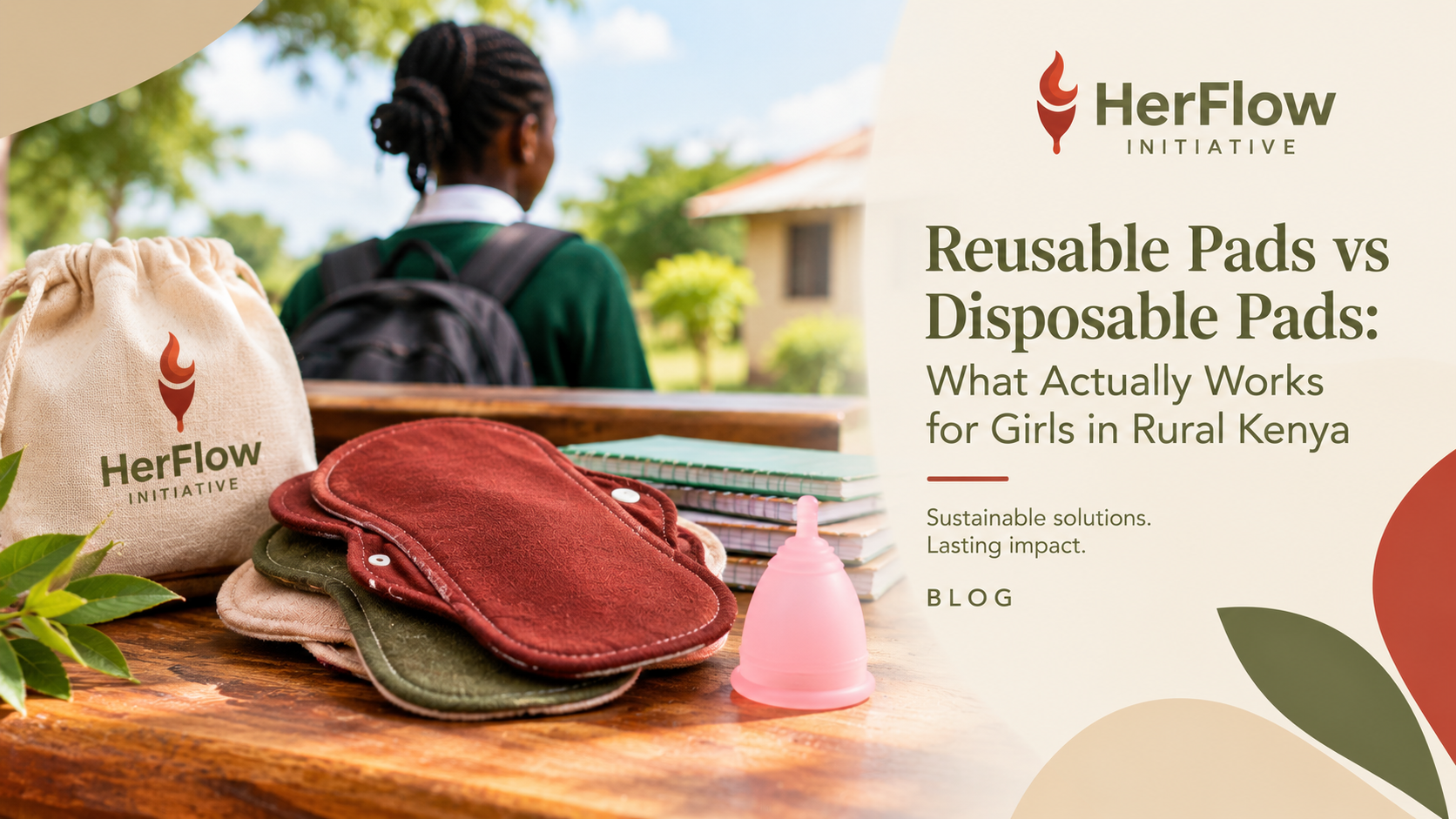
Reusable Pads vs Disposable Pads: What Actually Works for Girls in Rural Kenya
Ask a girl in Sondu what she needs most, and the honest answer usually is not a brand of pad. It is something that works next month too, without her having to find money for it again in three weeks.
That single fact is why the reusable versus disposable question matters so much more in rural Kenya than it does in a conversation about convenience. This is not a lifestyle choice. It is a math problem a girl and her family solve every single month, and the answer changes what her education looks like.
The real cost of disposable pads, month after month
A pack of disposable pads is not expensive in isolation. It becomes expensive when you multiply it by twelve months a year, for every menstruating girl in a household, for years, on top of school fees, food, and everything else a family is already stretching to cover. For a household living on a low or irregular income, that recurring cost is often the first thing cut when money is tight, and the girl is the one who absorbs the shortfall.
This is the core reason period poverty in Kenya is not a one time crisis to solve with a single pad donation. It is a recurring cost, and any real solution has to survive being recurring.
Where reusable products change the equation
Reusable cloth pads, and in some programs menstrual cups, shift the cost from monthly to occasional. A well made reusable pad, cared for properly, can last one to two years. That means a single distribution or purchase can cover a girl through several school years instead of a single term, which is exactly why organizations working on sustainable menstrual health solutions in Kenya, including groups distributing reusable products alongside education, have leaned into this model over the last decade.
The environmental case matters too. Disposable pads generate ongoing waste in communities that often lack reliable waste management, while reusable products create far less. But for a girl deciding whether she can afford to go to school this week, the environmental argument is secondary. The real argument is durability. A product she does not have to re-buy every month is a product that cannot suddenly become unaffordable at the wrong time.
Where reusable products still require support, not just distribution
Reusable pads only work if a girl has consistent access to water for washing, privacy to dry them without shame, given the stigma still attached to visible menstrual products in many communities, and basic education on how to care for them hygienically. Handing out reusable pads without addressing those three things does not solve the problem, it just changes what the problem looks like.
This is where product distribution alone tends to fall short, and where product distribution paired with education tends to actually work. A girl who understands her own cycle, knows how to clean and store a reusable pad properly, and has somewhere private to do it, gets real, lasting use out of it. A girl handed the same product with no explanation and no privacy often reverts to whatever felt safer, even if it was less hygienic.
So which one is actually better
Disposable products still matter, especially in emergency distribution, in urban settings with reliable water access, and for girls who prefer them once cost is not the deciding factor. But for the specific, recurring crisis of period poverty in rural Kenya, where the barrier is a monthly cost a family cannot sustain indefinitely, reusable products paired with hygiene education are the model that keeps working after the first term, the first year, the first donation drive ends.
The honest answer is not one product beats the other everywhere. It is that any solution has to be judged by whether it still works in month fourteen, not just month one.
What this means for how we work
This is part of why menstrual health work in Kenya that lasts is built around durability and education together, not a single product drop. A girl who is taught how her body works, given a product built to last, and supported by someone she can ask questions to, stops treating her period as an emergency to survive and starts treating it as something ordinary, because it is.
Her Flow Initiative's work in Sondu, Kisumu County is built on that same logic, dignity support paired with mentorship and education, because a product without understanding rarely outlasts the first few months, and a girl deserves a solution built for her next ten years of school, not just her next period. If this approach makes sense to you, follow what we are building, and consider supporting it. A gift that funds something durable is a gift that keeps a girl in class long after the donation itself is forgotten.
Questions people keep asking about reusable pads in Kenya
How long does a reusable pad actually last? A well made, properly cared for reusable cloth pad typically lasts one to two years, compared to needing a new disposable pad every single cycle. That difference is what turns a recurring monthly cost into an occasional one.
Are reusable pads hygienic if water access is limited? They can be, but only with proper education on washing, drying fully in sunlight, and safe storage. Distributing reusable products without teaching hygienic care can create new health risks rather than solving the original problem, which is why education has to travel with the product.
Do menstrual cups work as an alternative in rural Kenya? Some programs have introduced menstrual cups successfully, and they last even longer than reusable pads, often several years. They require more initial education and comfort with insertion, so uptake tends to depend heavily on how much guidance and privacy a girl has access to.
Why not just give everyone disposable pads and skip the complexity? Because the underlying problem is recurring cost, and disposable products do not remove that cost, they just delay it to next month. A solution built to be durable is a solution that still works after the first donation drive ends.
Sources: The Borgen Project, Global Citizen, African Development Choices.
Why Menstrual Health Education Matters as Much as the Products
Give a girl a pack of pads and you solve this month. Teach her what is actually happening in her body, how to track it, what is normal and what is not, how to talk about it without shame, and you solve something much bigger than this month. That is the part of period poverty that gets left out of most conversations, because pads are easy to photograph and hand out, and education is slower, quieter, and harder to put on a donation page.
But the data is clear about which one moves the needle further.
What girls in Kenya are actually taught, or not taught, about their bodies
Research summarized by human rights organizations working on menstrual health in Kenya has found that around 70 percent of girls say menstruation affects their grades, and more than half report falling behind in school specifically because of it. Those numbers are not only about access to pads. They reflect girls who do not know what to expect, panic when their period is irregular or painful, and have no trusted adult to ask, because menstruation is still treated in many households and schools as something to whisper about rather than explain.
That silence has a cost that outlives the pad shortage. A girl who does not understand her own cycle cannot plan around it, cannot recognize when something is actually wrong medically versus normal, and often absorbs shame that follows her well beyond her school years.
The stigma is doing as much damage as the cost
Reporting on period poverty in Kenya has documented girls using rags, sponges, or other unsafe materials, not only because they cannot afford pads, but because asking for help means admitting, out loud, that they are menstruating, in communities where that admission still carries stigma. Some girls have turned to transactional relationships specifically to obtain sanitary products quietly, without involving a parent or teacher, which shows how strongly shame, not just cost, shapes a girl's choices.
You cannot fix a shame problem by only fixing a supply problem. If a girl is still too embarrassed to ask a teacher for a pad, having pads in the store room does not help her if she does not know they exist, does not know how to ask, or has been taught that asking marks her out.
What real menstrual health education actually covers
Good menstrual health education is not one assembly about biology. It covers what a normal cycle looks like and what is worth seeing a health worker about, how to use and care for whatever product a girl has access to, safely and hygienically, how to talk to a parent, teacher, or mentor about it without feeling like a failure, and how to plan around it so a period stops being an emergency and starts being something she manages like any other part of her routine.
That last shift, from emergency to routine, is the entire goal. A girl who has been taught this treats a heavy day as something to plan for, not something to hide from. A girl who has never been taught this treats every period as a new crisis, every single month, for years.
Why mentorship is the piece that makes education stick
Information alone fades. A pamphlet handed out once in a classroom rarely changes behavior on its own. What changes behavior is a trusted adult a girl can actually go back to when something confuses or worries her, months after the initial lesson. That ongoing relationship, more than any single workshop, is what turns menstrual health education from a one time event into something a girl actually carries with her.
This is why organizations that pair education with mentorship tend to see it stick in a way that a single training session does not. A girl who has a mentor she trusts is a girl who asks the question instead of guessing, and guessing is where most of the shame and most of the unsafe workarounds come from.
How Her Flow approaches this
Her Flow Initiative's work in Sondu, Kisumu County is built around exactly this pairing, dignity support delivered alongside a mentorship program and education through Kitabu kwa Msichana, because a girl who understands her body and has someone to ask is a girl who stops missing school out of fear or confusion, not just out of cost.
If you have ever assumed period poverty is only a product shortage, this is the part worth sitting with. It is also a knowledge gap and a silence problem, and closing it takes people showing up consistently, not a single donation drive. Follow the work we are doing in Sondu, and if this matters to you, support it. The education side of this work rarely gets funded as easily as products do, which is exactly why it needs people who understand why it matters.
Questions people keep asking about menstrual health education in Kenya
Does menstrual health education actually improve school attendance? Research summarized by human rights organizations working in this space has linked menstrual health education directly to reduced absenteeism and better academic outcomes, since girls who understand and can plan around their cycle are less likely to stay home out of fear or confusion.
At what age should menstrual health education start? Most effective programs start before a girl's first period, not after, so she recognizes what is happening and knows how to respond instead of encountering it for the first time with no context. Waiting until after menarche means the education arrives after the fear already has.
Why does stigma persist even where education programs exist? Because a single lesson does not undo years of cultural silence. Stigma fades through repeated, normal conversation over time, ideally reinforced by a trusted mentor a girl can return to, not a one time classroom session that is never mentioned again.
Is menstrual health education a boys' issue too? Yes. Boys who grow up without any menstrual health education often become the source of teasing and stigma that keeps girls silent and ashamed. Programs that include boys tend to see less bullying and more support for girls managing their periods at school.
Sources: KELIN Kenya, The Borgen Project, Kenya News Agency.